
TL;DR: Understanding IP address classes can help you plan your network right. Class A gives you a huge pool of addresses for large setups while Class C offers a smaller, more focused range for tighter environments.
Have you ever wondered if your network is using its address space as efficiently as it could? Different IP classes serve different needs. Class A networks are like a busy freeway designed to handle millions of devices. In contrast, Class C works more like a small neighborhood where space is limited.
Knowing the difference can save you time and hassle when setting up your network. Match your design to the right IP class and avoid potential headaches down the road.
ip address class a vs class c: Clarity
IPv4 addresses are 32-bit numbers written in dotted-decimal form. They let devices like computers and smartphones connect on a network. In classful addressing, these numbers are divided into five groups (A, B, C, D, and E) based on which bits mark the network part and which mark the host. Even though newer methods are more flexible, classful addressing still helps us understand how networks work.
Class A addresses use the first octet (8 bits) for the network, covering IDs from 1 to 126. The remaining 24 bits are for hosts. This setup supports millions of hosts per network and works well for very large deployments. In contrast, Class C addresses reserve the first three octets (24 bits) for the network, with IDs ranging from 192 to 223, and only the last octet (8 bits) for hosts. This design limits each Class C network to 254 devices but allows for many networks overall.
Understanding these differences is key for good network planning. Knowing how Class A and Class C divide their bits helps network designers pick the right address scheme based on the size and needs of the network. Before CIDR was around, knowing classful addressing inside and out was essential for setting up stable networks.
IP Address Class A and Class C Bit Structure
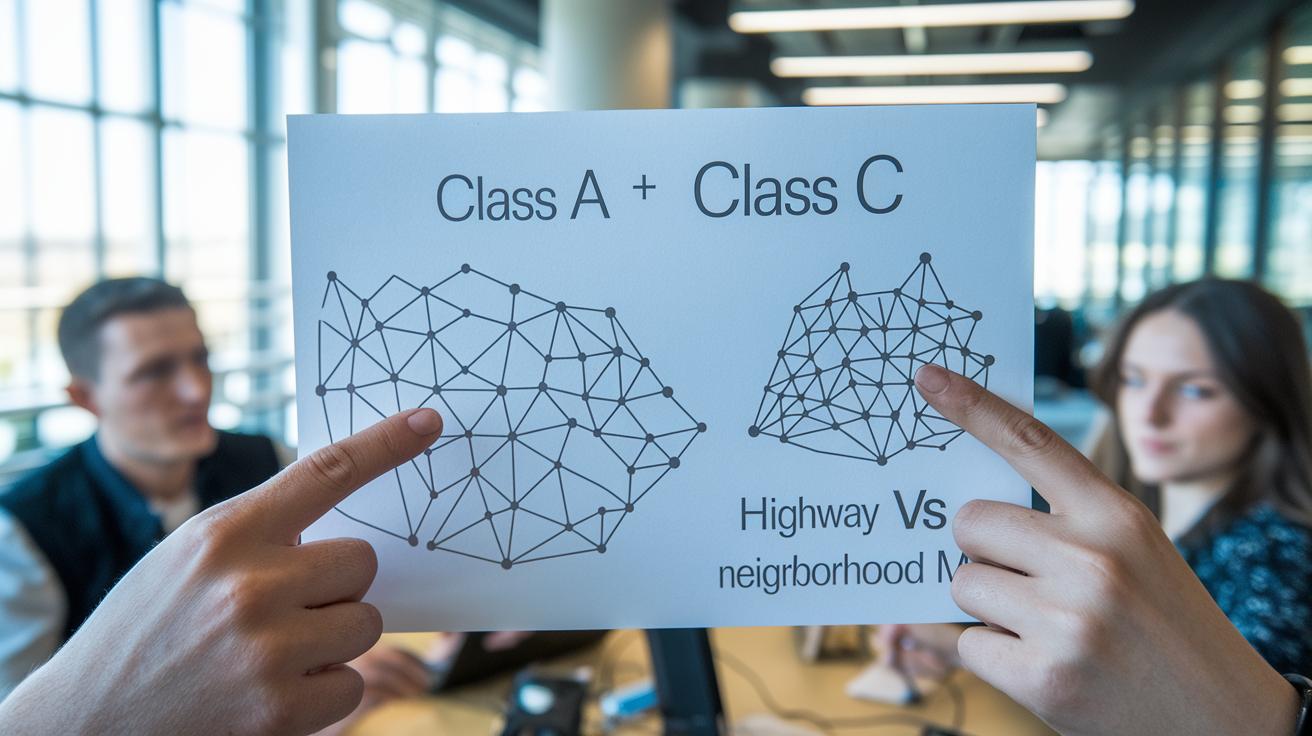
For Class A addresses, the binary setup fixes the first bit at 0. This means the network IDs range from 1 to 127, while the other 24 bits are reserved for hosts. In simple terms, each Class A network can support nearly 16.8 million (2^24 – 2) devices. It's like having a highway that can handle an almost endless stream of cars.
Class C addresses work a bit differently. Here, the first three bits are set to 110, which confines network IDs to values between 192 and 223. With only 8 bits left for host addresses, each Class C network can accommodate just 254 (2^8 – 2) devices. Think of it as a small neighborhood with limited space for homes.
| Class | Network Bits | Host Bits | Max Hosts |
|---|---|---|---|
| Class A | 8 | 24 | 16,777,214 |
| Class C | 24 | 8 | 254 |
Class A vs Class C Address Range and Capacity
Class A and Class C differ clearly in how they organize networks. Class A covers addresses from 1.0.0.0 to 126.255.255.255. It supports 126 networks, with each network able to handle millions of hosts. This makes it perfect for large organizations that need a lot of room for many devices.
Class C, on the other hand, ranges from 192.0.0.0 to 223.255.255.255. It offers about 2,097,152 networks but limits each one to only 254 hosts. This smaller capacity makes Class C a common pick for small businesses and local setups.
Below is an HTML table that summarizes the key facts:
| Range Type | Address Range | Number of Networks | Hosts per Network |
|---|---|---|---|
| Public Class A | 1.0.0.0 – 126.255.255.255 | 126 | Millions |
| Public Class C | 192.0.0.0 – 223.255.255.255 | ~2,097,152 | 254 |
In addition, there are common private ranges. For example, a typical private Class A network is 10.0.0.0/8, which also supports millions of hosts. A common private Class C example is 192.168.0.0/16, which fits well for home and office networks.
These differences in how many networks and hosts each class supports are important when planning and allocating addresses for your network needs.
Class A and Class C Use Cases

Class A addresses are best for large organizations such as big companies, ISPs, and government agencies that need to support millions of devices. They often use the private 10.0.0.0/8 block in big VPNs and data centers. This range works well in cloud setups and large data centers because it offers a flexible and strong addressing scheme. For example, one enterprise might run several services across different regional offices without worrying about running out of addresses by using Class A.
Class C addresses, on the other hand, are a better fit for smaller networks. They suit small businesses, departmental LANs, and home routers, as they allow up to 254 devices per network. This makes setup and management simple and efficient, perfect for limited networks like those in homes or small offices.
Real-world deployments include:
- A major telecommunications company using private Class A blocks for its nationwide data centers.
- An ISP managing thousands of subscribers over broad areas by using Class A ranges.
- A university campus dividing its network into multiple Class C subnets for academic, administrative, and research use.
- A small business keeping its office network simple and cost-effective with Class C addressing.
Class A, Class C and the Shift to CIDR
In 1993, CIDR was introduced to cut down on wasted addresses from the old classful system. Instead of fixed Class A or Class C boundaries, it uses flexible subnet masks that let network admins group addresses more in line with real needs, like using /19 or /22 bits. This method gives you a better fit for your network, saving many unused addresses compared to traditional schemes.
IPv6 came next to solve the IPv4 address shortage by offering a 128-bit addressing setup with a massive pool of addresses. Even though IPv6 supports almost endless numbers, many legacy systems still run on Class A and Class C setups. That’s why a solid grasp of these basics remains important.
Today, network professionals often use CIDR techniques when moving over to IPv6. This helps them manage transitions and troubleshoot across both modern and older systems. The evolution from classful addressing to CIDR, and now to IPv6, shows the industry’s ongoing effort to boost efficiency and scalability.
Final Words
In the action, we reviewed IP address fundamentals, focusing on Class A and Class C basics. We broke down each class's bit allocation and numeric range and explored real-world scenarios for large organizations versus small networks. You saw how these classic addressing methods stack up against modern CIDR practices and why understanding them matters for planning effective networks.
Overall, the guide offers clear comparisons for ip address class a vs class c. It leaves you with practical insights to boost confidence when setting up or upgrading your network.
FAQ
Q: What is the difference between Class A and Class C IP addresses?
A: The difference between Class A and Class C IP addresses is that Class A reserves one octet for the network, allowing millions of hosts per network, while Class C uses three octets for the network, supporting up to 254 hosts per network.
Q: What are the typical IP address class ranges?
A: The usual ranges are Class A (first octet 1–126), Class B (first octet 128–191), and Class C (first octet 192–223), which accommodate varying network sizes and numbers of hosts.
Q: What is the Class C IP address range?
A: The Class C IP address range spans from 192.0.0.0 to 223.255.255.255, offering many small networks that can support up to 254 hosts each.
Q: What is a common example of a Class A IP address?
A: A typical Class A IP address example is 10.0.0.1, often used in private networks for large organizations.
Q: Is 192.168 a Class C address?
A: The address range starting with 192.168 falls under Class C, and it is widely used in private home and small business networks.
Q: Is /24 a Class C subnet?
A: The /24 notation corresponds to a subnet with 256 addresses, which is the standard size for Class C networks, making it a common subnet mask for these addresses.
Q: Is 127 a Class A or Class B address?
A: The 127.x.x.x range is reserved for loopback and testing purposes and falls within the Class A range, despite its unique role in network operations.
Q: What does the term IP address Class B refer to?
A: Class B addresses use the first two octets for the network part and range from 128.0.0.0 to 191.255.255.255, suiting medium-sized networks.
Q: How is Class A, B, and C IP addressing discussed on Reddit and similar forums?
A: Discussions on Reddit compare these classes by highlighting that Class A offers a massive host capacity, Class B serves medium networks, and Class C provides compact addressing ideal for small-scale setups.